Flavor goes in before roasting
Supercritical CO₂ carries natural flavor deep into the green bean, so it roasts as part of the coffee.
Specialty whole-bean coffee with natural flavors. Roasted in Texas by a team that has built a roastery before.
My partners and I built Blue Mondays, a roastery and café in Bratislava. Together we grew it from one barista to a team of 10–12. It was profitable every year and reached €581k ($655k) in revenue in 2025.
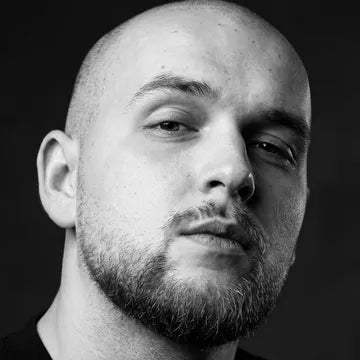
Over 10 years in hospitality, from barista to manager. At Blue Mondays he learned roasting, cupping and green coffee sourcing, and ran B2B sales. A trained graphic designer, he makes the brand and content in-house. At launch he roasts, flavors, packs and runs social media.

Years of hospitality experience and a background in social anthropology. At an advertising agency she managed supplier communication. She leads outreach to cafés, offices and partners.
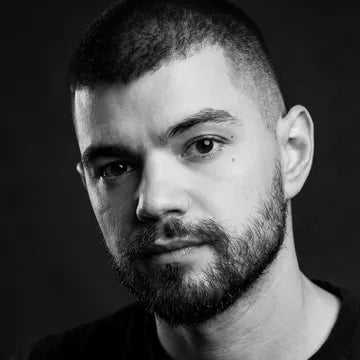
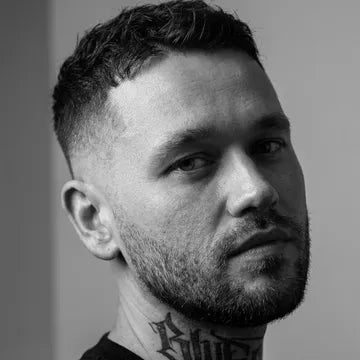
The original founders of Blue Mondays, a successful roastery and café in Bratislava. Two non-managing members with 33% each, who invested their own money. They are not involved in daily operations.
Today's coffee drinkers want flavor and read the ingredient panel. Read it for yourself.
Ingredients as listed on each brand's product page, checked November 2026.
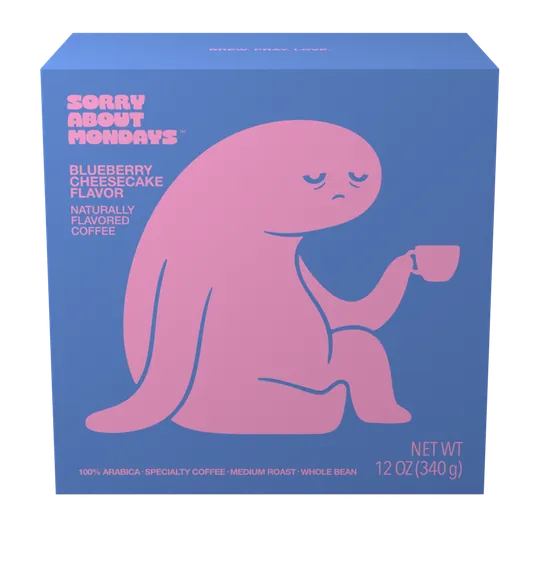
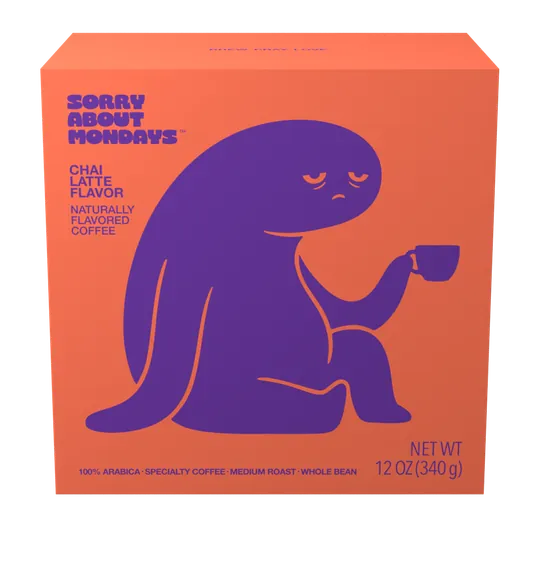
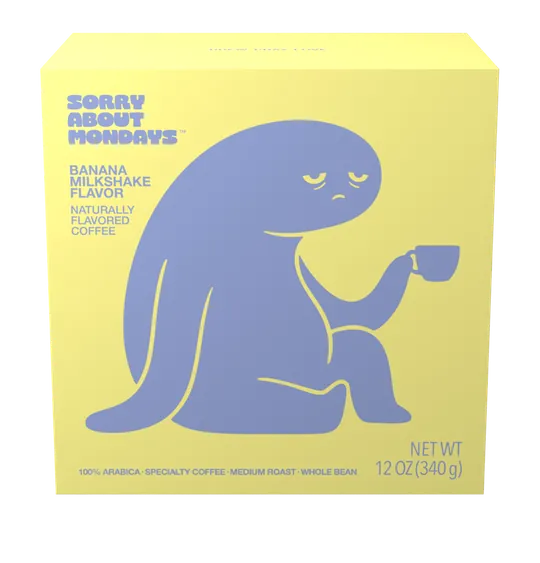
Specialty-grade Arabica, medium roast, whole bean.Three flavors to choose from.And a quality single origin for those who prefer a classic cup.Drag the box to turn it.
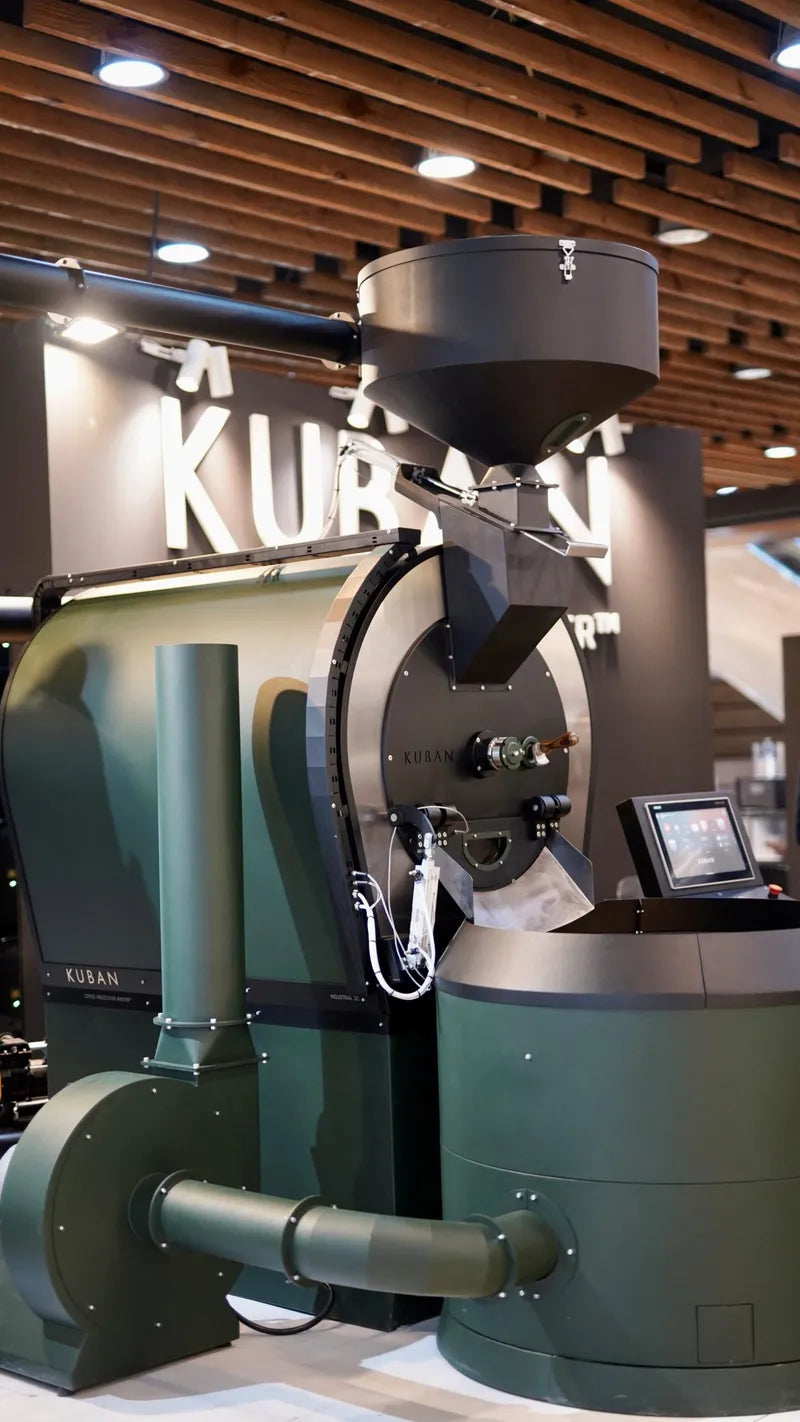
Fully automatic drum roaster. It repeats our saved roast profiles batch after batch and roasts the next batch while the last one cools.
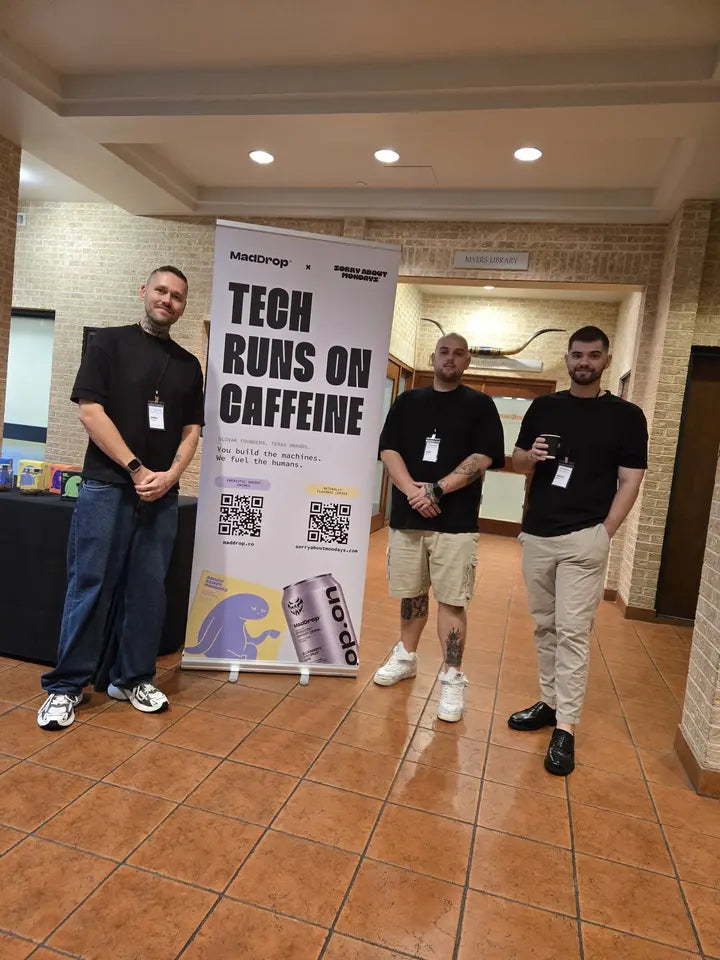
About 55 people tasted our coffee at the DRON8 Summit 2026 at UT Austin. It was a tech crowd, not a coffee crowd, and 1 in 5 wanted to buy.
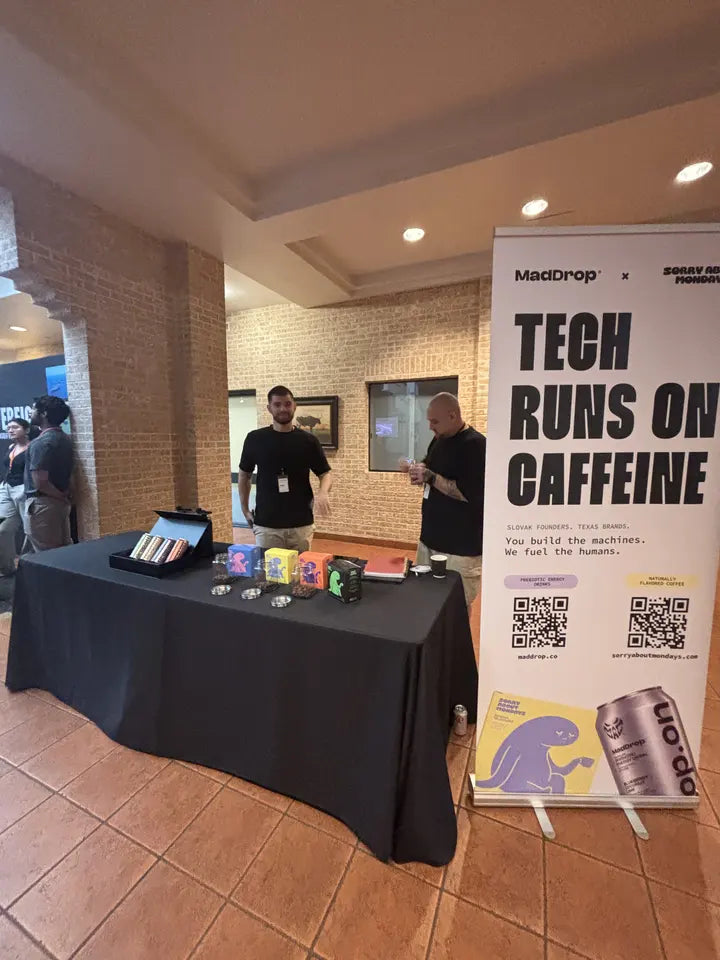
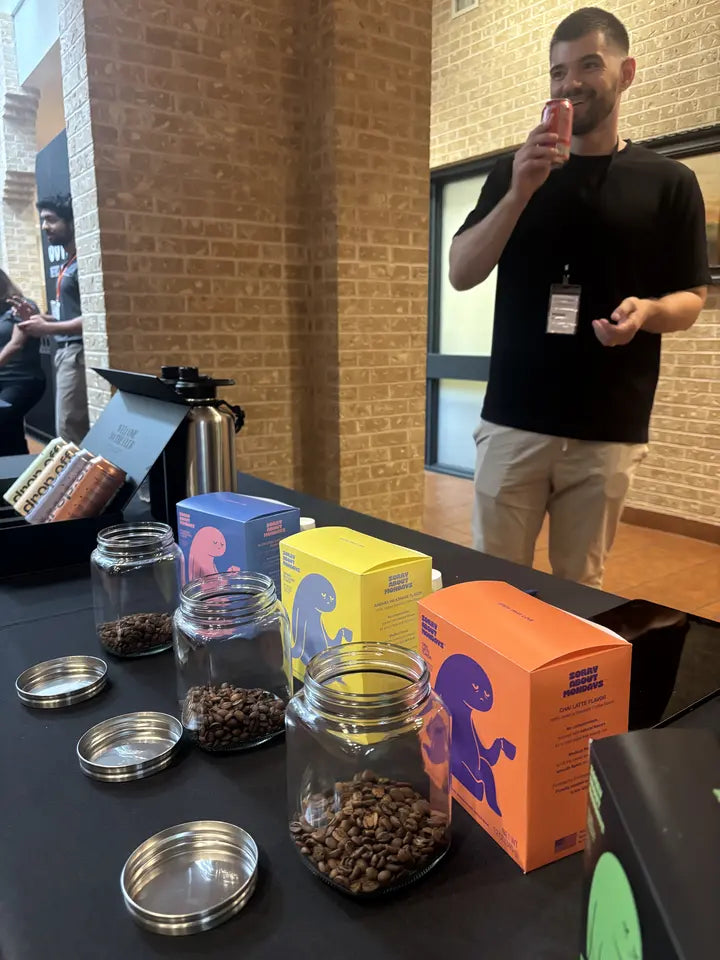
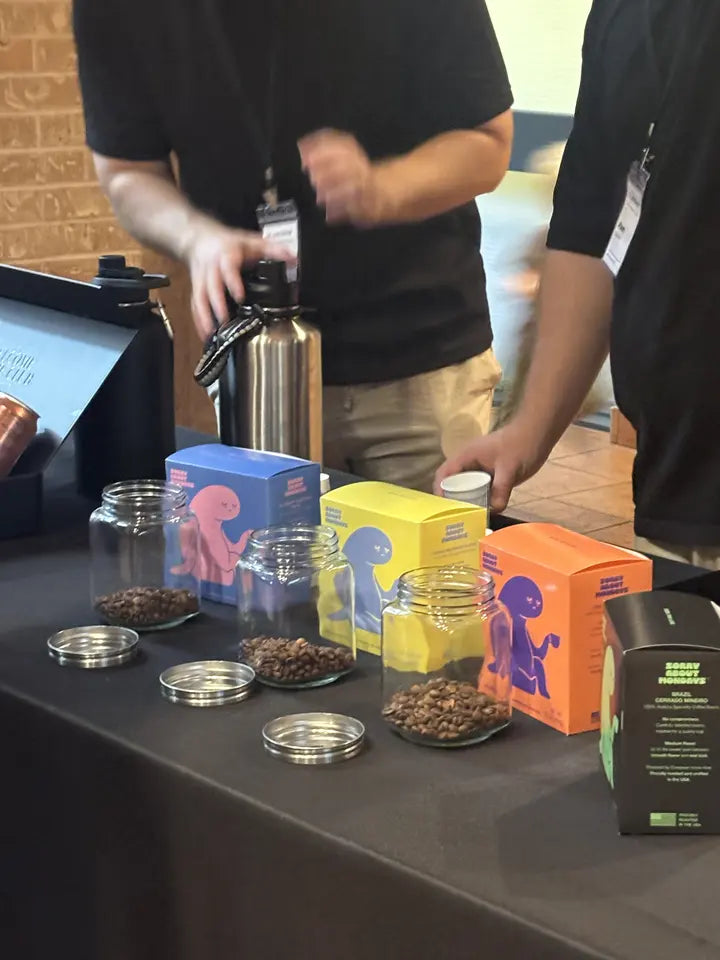
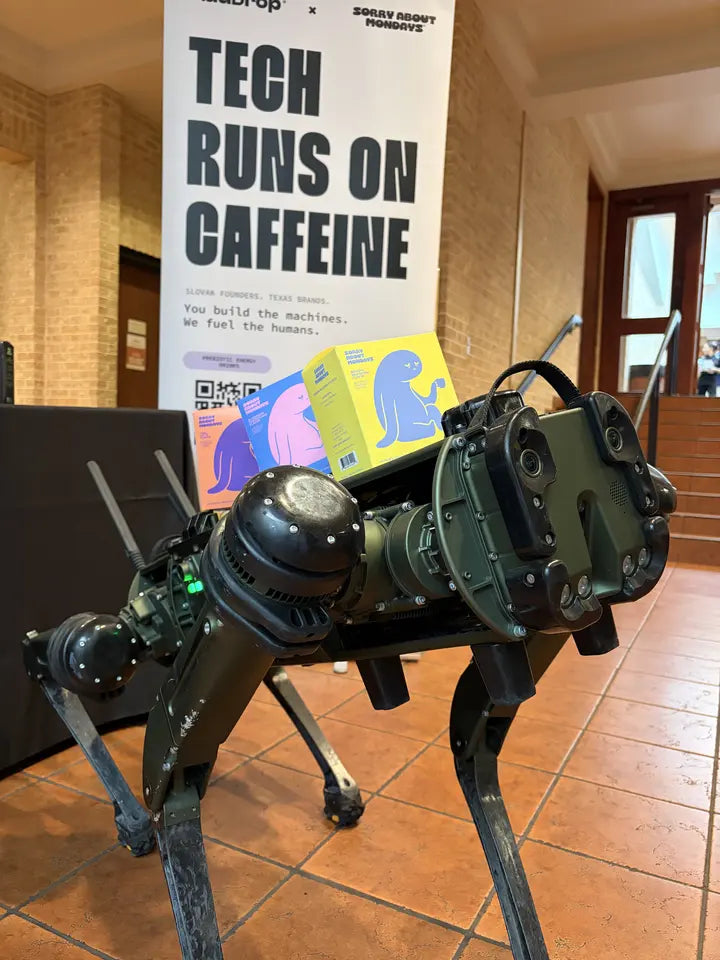
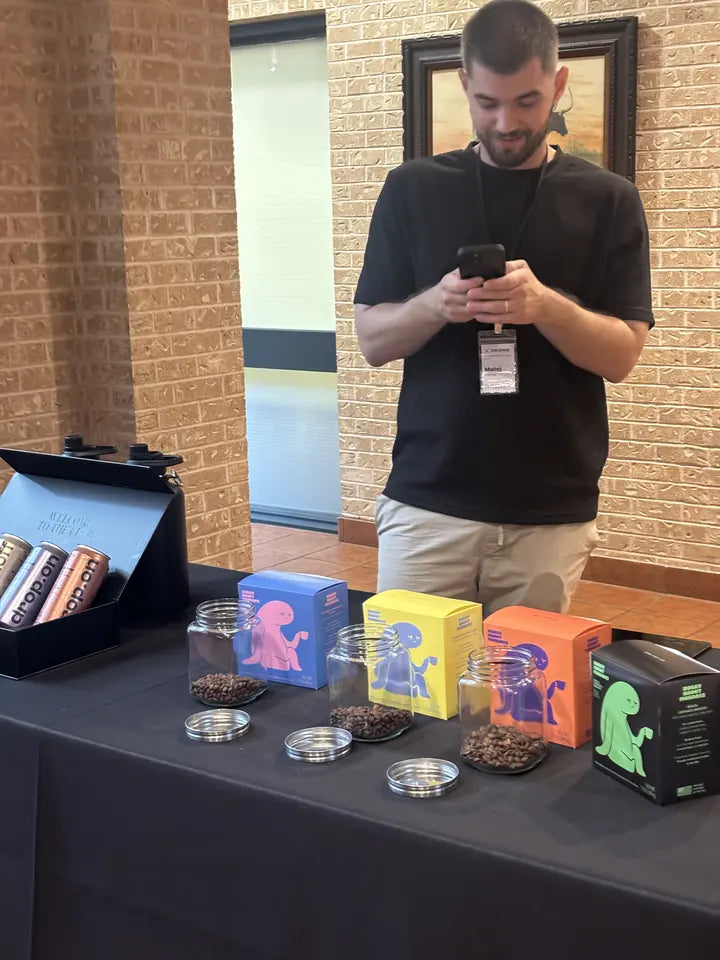
Our core customer is 18–39, skews female and already drinks specialty coffee. They like flavor but avoid artificial ingredients. Most brew at home, which suits a whole-bean bag.
A young city with a growing specialty scene. The Austin metro has about 1.42 million jobs. About 291,000 are in professional and business services, the offices we sell coffee to wholesale.
Texas has about 9,146 coffee and snack shops. About 5–6 kg of coffee a day covers our fixed costs, and 50 accounts take us well past that.
National Coffee Association, 2026 NCDT Specialty Coffee report · BLS, Austin-Round Rock-San Marcos, Sept 2026 (prelim.) · IBISWorld, Texas Coffee & Snack Shops, 2026. The female skew rests on older surveys (2017–2018).
Our direct competitors are playful brands with dessert flavors. Starbucks and Dunkin' also sell flavored coffee. They are mass-market brands built on commodity beans, and we target a different customer.
| Brand | Flavoring | Beans | Price / 12 oz | Where |
|---|---|---|---|---|
| SORRY ABOUT MONDAYS™ | Natural flavors only | Specialty-grade Arabica, whole bean | $15.00 | Own e-shop, wholesale; retail next |
| Bones Coffee | Natural and artificial flavors | “Premium arabica” | $17.99 | E-shop, Walmart, Costco |
| Java Factory | Not stated on label listings | “100% Arabica”, sold ground (10 oz bags) | ~$17.94* | Amazon, Target, H-E-B, own site |
| Starbucks / Dunkin' | Mass-market flavored lines | Commodity, mostly ground | ~$11 | Everywhere |
From brand and retailer product pages, November 2026. *Java Factory sells 10 oz bags for $14.95 on Two Rivers Coffee Direct, its sister store. We scaled the price to 12 oz. Its product pages do not say whether the flavoring is natural or artificial.
About diacetyl. Diacetyl (2,3-butanedione) is a chemical that gives a buttery taste. The FDA lists it as safe as a food ingredient (21 CFR 184.1278). It is common in butter, caramel, vanilla and butterscotch flavorings, including flavorings for coffee (OSHA, NIOSH). The known risk is inhaling it. Workers exposed to its vapors have developed bronchiolitis obliterans, an irreversible lung disease often called "popcorn lung." NIOSH found high levels at a coffee roasting and flavoring plant (HHE-2018-0134). Roasting also produces small amounts naturally, so our claim covers diacetyl added through flavorings.
Our e-shop has the highest margin, and we own the customer data. Our roaster handles up to 2,205 lb (1,000 kg) a day, far more than direct sales need early on. Wholesale and white label use that capacity, cover fixed costs and bring steady cash flow.
Why it is our safety net. Wholesale orders are large and repeat on a schedule. A handful of accounts covers our fixed costs of about 5–6 kg a day. They use spare roaster capacity, do not depend on brand awareness, and keep cash coming in if the e-shop grows slower than planned.
Green coffee is about 60% of cost. We are not tied to one origin, so if prices rise, we can switch farms or importers without changing the product. Price is our second lever. Customers pay shipping on orders under $50.
$10,400 in packaging covers 20,000 bags, worth $300,000 at retail. 40% goes to marketing and sampling. The rest funds a nine-month reserve for rent and fuel, plus green coffee and flavoring for about 3,000 bags. The investment buys equity, so the company does not pay it back.
| Marketing & sampling detail | Planned | What it buys |
|---|---|---|
| Sampling & freebies | $10,000 | 1,000 free 12 oz bags ($7,370) for cafés, buyers, creators and customers, plus merch ($2,630): stickers, T-shirts, caps and other small items |
| Paid social | $7,000 | Instagram, TikTok and Meta ads driving e-shop orders |
| Events & tastings | $13,500 | Stands, festivals and promo packs |
| Content | $9,500 | Photo and video for social and ads |
The marketing split is a rough estimate and can change with our needs. We track each channel by cost per customer and move budget to what works. This round pays for marketing, so it is not in the operating projection. This round does not fund the CO₂ flavor project (section 13).
Fixed costs are rent and fuel, $3,350 a month. One employee joins in year 2 and a second in year 3. The base case assumes half our planned volume. The upside case is the plan.
Assumptions: Volume grows in a straight line to ¼, ½ and the full year-3 target (base 100 kg/day, upside 200 kg/day). Half the coffee by weight sells direct, half wholesale. Direct: $44.09/kg revenue, $20.30/kg product cost ($6.91 per bag). Wholesale: $35.27/kg revenue, $19.26/kg product cost. Product cost covers green coffee, flavoring, packaging, pallets and propane. Fixed costs are rent and energy ($3,000) plus fuel ($350) a month. This round pays for marketing, so it is not counted here. Staff: one employee in year 2 and two in year 3, each about $54,200 a year. That covers $20/h full time, payroll taxes, health insurance and a 3% retirement match. All net profit is paid out to members. The model leaves out payment fees, shipping on free-shipping orders, insurance, depreciation and income tax, so real profit will be lower.
Set the year-3 volume and team size to see the result. Company value is 0.63× annual revenue, the average sale multiple for small US food manufacturers.
At 100 kg/day the model matches the base case; at 200 kg/day it matches the upside. Payouts follow the operating agreement.
Multiple from BizBuySell, businesses sold Q3 2021–Q2 2026.
Our roaster handles up to 2,205 lb (1,000 kg) a day. We can shift that capacity to toll roasting and white label at any time, so the roastery earns even if the brand grows slower.
Wholesale gives a stable base. We lean on sampling, affiliates and events, and track the return on every channel.
We are not tied to one origin. We can switch farms or importers and adjust pricing if needed.
We also offer a single origin, Brazil Cerrado, and can rotate flavors quickly without new equipment.
We can roast ahead to build a stock buffer. A new hire can learn to roast quickly.
Our roaster is fully automatic. It gives consistent quality, full control over every roast, and room to grow without adding staff at the same rate.
Our biggest goal is a flavoring method few roasters use: infusing natural flavor into green coffee with supercritical CO₂, before roasting. The flavor moves into the bean and roasts as part of the coffee. It uses the same CO₂ technology that decaffeinates coffee worldwide, run the opposite way so the caffeine stays in.
This is not part of this investment. None of the $100,000 goes to it. We start it only when the company's own profits can pay for the custom-built pressure vessel and the pilot.
Supercritical CO₂ carries natural flavor deep into the green bean, so it roasts as part of the coffee.
Dry green beans, straight from the sack, and natural flavor go into the sealed vessel. No soaking.
CO₂ is pumped into the sealed vessel under high pressure.
With gentle, low heat the CO₂ turns supercritical: it flows like a gas and dissolves like a liquid, carrying flavor into the bean.
After a hold time, pressure comes down slowly. CO₂ leaves as gas; the flavor is meant to stay in the bean.
CO₂ is captured for the next batch, and the infused beans go to the roaster.
CO₂ decaf soaks the beans, runs hot for hours and filters the caffeine out of the CO₂. We run the opposite: dry beans, low heat, a closed vessel, short holds. Every pilot batch gets a lab caffeine test.
CO₂ turns supercritical above 31.1 °C and 73.8 bar. We work above that point at low heat, gentler on the bean than classic CO₂ decaffeination. Exact settings come from the pilot.
Based on the standard supercritical CO₂ loop used in commercial systems such as Separeco and lab units like this SFE installation. Final sizing and certification (ASME or PED) come with the vessel builder.
We expect CO₂-infused coffee to taste closer to the real food than typical flavored coffee. We also expect it to keep its flavor longer, because the flavor sits inside the bean, not on it. We have not measured this yet. The pilot's tasting panels will test it.
| Typical flavored coffee | CO₂ infusion, our goal | |
|---|---|---|
| Where the flavor sits | Coated on the roasted bean 1 | Carried into the green bean. CO₂ already reaches inside whole green beans to remove caffeine 2 |
| Heat | Added after the beans cool, because roasting heat can destroy flavor compounds 1 | Infused at low heat; CO₂'s low critical temperature spares heat-sensitive compounds 3. Surviving the roast is what the pilot must prove |
| What's left behind | Flavor oils or carriers on the surface 1 | CO₂ leaves as a gas, with no solvent residue 2 |
| Caffeine | Untouched | Kept in. CO₂ decaf needs beans soaked to 25–50% moisture, 70–140 °C and 2–13 hours 5; we use dry beans at about 10–12% moisture 6, low heat and short holds, and lab-test every pilot batch |
| Freshness | Best used within 2–4 weeks 1,4 | Expected to hold longer with flavor inside the bean; to be tested |
You get a stake in Hound Dogs Club LLC, the company behind SORRY ABOUT MONDAYS™. You share in profits paid out to members and in any future sale. A clear exit opens after three years.
The figure follows from the terms: $100,000 for 17% of the company. That values the company at about $488k before this round. Our hard assets are worth far less. The price reflects what we have already built:
Hound Dogs Club LLC, a Delaware limited liability company registered in Texas as a foreign LLC. It does business as SORRY ABOUT MONDAYS™ (assumed name registered) and holds a Texas Sales and Use Tax Permit. Roastery and warehouse in Georgetown, Texas.
Managed by Alan Hučko, CEO and sole managing member. The two other members are investors and do not manage the business.
Final terms are subject to a written agreement prepared by counsel.